We are always learning and developing as woodworkers. In these pages you'll find what's inspiring us right now.
Friday, July 22, 2016
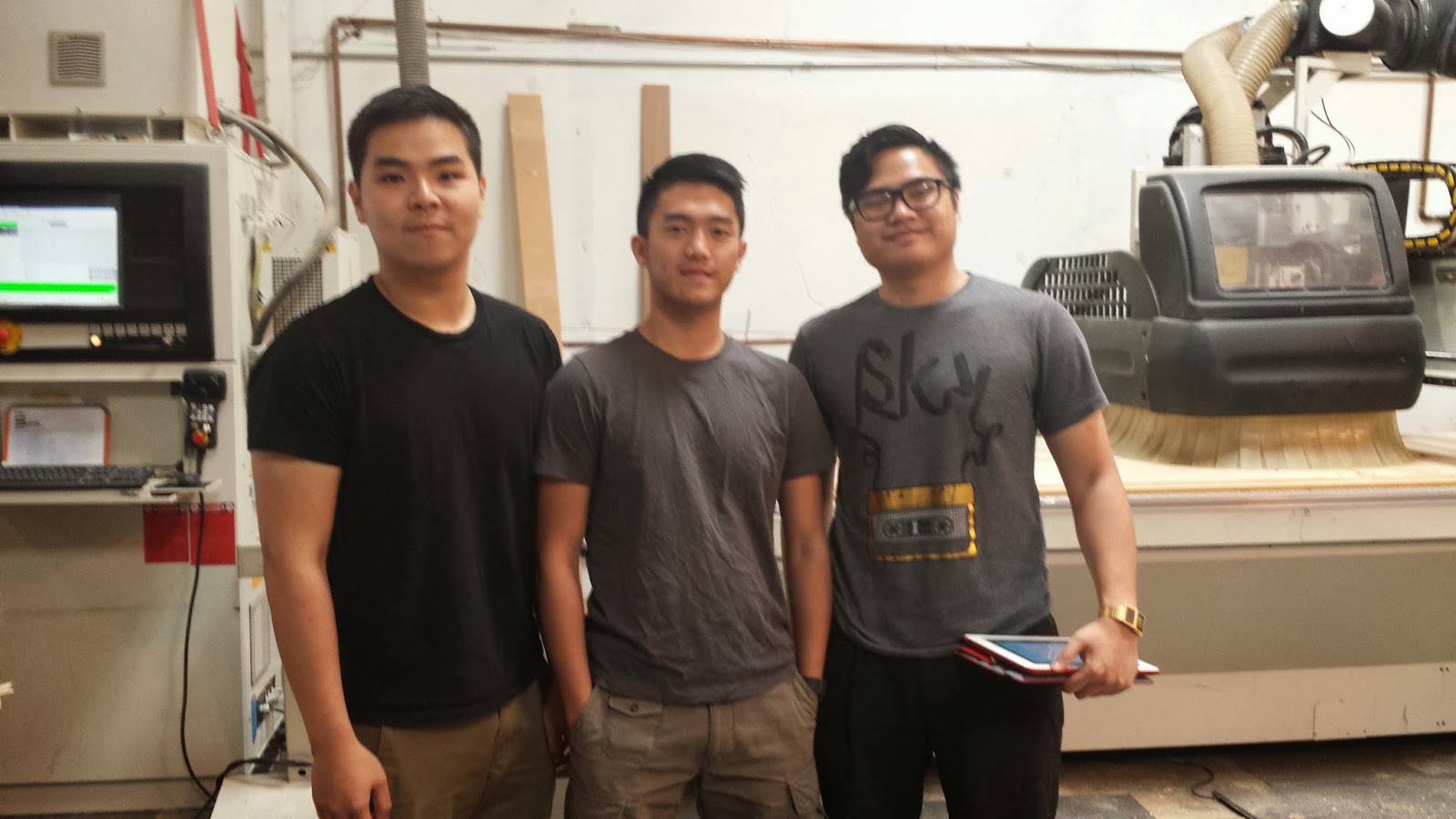
Welcome Nik Patel, Summer Intern!
We are pleased to have Nik Patel working with us this summer. Nik is an incoming senior at John O'Connell High School in San Francisco. He's at our shop due to collaboration between John O'Connel, his woodworking instructor there, Chris Woods, the SFUSD and Jewish Vocational Service.
In our shop, Nik has gained experience operating and programming our CNC router, has spent lots of time with his hands on work in our finishing department, has visited job sites and been present at problem-solving discussions with clients. He hopes to spend time assembling and installing cabinets, to begin his development of these skill sets.
Nik is interested in studying architecture or design after graduating from John O'Connel next year. He has a great attitude and is a welcome addition to Seidman Woodworks.
It's all in a good day's trade. Joe Di Maio repaired a burst coolant line on our cnc router and in return requested some time on the machine. Today, he made a prototype pattern for Saleh Aboutaleb, who hopes to use the pattern to improve his mosque. If the pattern is accepted, we will hopefully be cutting over 20 of these. Based on this and the last post, I see a definite pattern (sorry about the pun) emerging.
Saleh Aboutaleb and Joseph DiMaio cut out this pattern on our CNC
Saleh Aboutaleb demonstrates how the proposed pattern will
wrap the pulpit at Mashid al Nur mosque in Richmond
We have the privilege of fabricating a torah-reading table for Or Shalom. The proposed design picks up on the architecture of the place of worship Or Shalom shares with Beth Israel Judea in San Francisco --tall vertical cherry panels behind the bima, but softening it with an oval shape. The technical challenge of the piece will be to get the wood to curve in two planes. Trees grow that way-- but milled wood does not like to be bent that way.
Here are the plans:
And here are a few images of a preliminary form for bending the cherry into shape:
The design is still in progress. Or Shalom and Beth Israel Judea need to give their final approval and we need to determine that we can in fact get our wood to bend in two planes, (The ribs shown are not part of the actual table but will instead be used as a form against which we will mold the cherry.)
John O'Connell High School students Xavier Villamor & Sean Zavala at work
We at Seidman Woodworks have the pleasure this Spring of having Xavier Villamor and Sean Zavala, both high school students, work in our shop. They come in each Thursday and put in a solid stint of work. They're getting a taste of working in a professional woodworking environment. They're getting to spend the time that it takes for the hands to develop their own intelligence. And we are getting to enjoy their great attitude, enthusiasm, and presence in our shop. It's a source of pride for all of us at Seidman Woodworks to be able to impart a little bit of what we know to the next generation.
Sean and Xavier's presence is made possible by a collaboration between John O'Connell High School, their woodworking instructor Chris Wood (would that every woodworker could have that name) and Jewish Vocational Service.
Sean and Xavier have a great attitude, are a pleasure to have in the shop, and represent exceptionally well the team that has made their presence here possible.
California College of the Arts students were at Seidman Woodworks this morning cutting parts on our cnc router for their portable art museum, which will be in the upcoming Market St. Prototyping Festival.
The structure will be a giant slinky, say CCA students (from right to left) Adika Djojosugito, Fredy Lim and Martin Setiawan, who collaboratively designed the project. They're working in conjunction with Larkin Street Homeless Youth, who will display their art on the outside. Inside is posted information for homeless youth on where homeless youth can go to find help and resources.
It's been very fun working with these young and talented community-minded designers and fabricators.
"All these techniques have been invented long before your time, honed to perfection over the centuries." These are the words of Genadi (spelling), a trapper in Russia's far North, recorded in Werner Herzog's film, "Happy People, A Year in the Taiga" (available on Netflix streaming). Genadi reflects on his trade while engaging in one of the most magnificent woodworking project I've ever seen: the fabrication of a pair of skis.
Using a small hand axe, a plane, a jig for bending the ski tips and not a whole lot else, Genandi produces a new pair of the skis that enable him to cross vast distances of the frozen Taiga and ply his trade.
Genandi's skis takes the concept that an object's form should be an expression of its function-- and elevates it. The skis also express the natural environment from which and in which they are made. They embody the passing of knowledge from one generation to the next. They help define the relationship of Genandi's remote village to modernity. They inform Genandi's understanding of himself. And most importantly, the skis are absolutely necessary. Just as the skis would not exist without Genandi their maker, Genandi would not exist --in the way that we see him in the film-- without these skis.
He starts by driving his exceedingly sharp hand axe into a living tree, parallel to the trunk, testing the grain for straightness. Everywhere are trees. They define the Taiga, a vast wilderness one and a half times the size of the United States. Genandi's task is to find the one tree that will serve him best, with grain perfectly straight, so that the skis will flex but not break. He fells the tree with a chain saw, cuts a section of trunk the length of the skis, then in short order fashions wooden wedges with his axe then drives these into the stem to split it along its length into boards. The wedges amplify Genandi's strength, so that he can talk at ease about his work as it progresses.
"Naturally you pick up things from others as you go along. A little bit here, a little bit there. You add your own improvements... You can't reinvent the bicycle." Just as Genandi was taught to make skis, he passes on his knowledge to his son, showing him how to steam-bend the tips. This is where I expected the whole narrative to break down. The son, surely, would find a way to purchase modern cross-country equipment then ski circles around his father, still trudging along on the crude, heavy, wooden slabs of yesteryear.
As it turns out, this is not the story of an old guy sticking stubbornly to old ways while the world changes around him. Genandi, by necessity, is an intensely practical man. He owns a snowmobile and a chainsaw, because these help him work. But when it comes to skis, the purchased item is inferior. "You may have those factory-made ones. You and I go into a wood, you'll drop dead from fatigue after 15 kilometers. You won't be able to move a leg. Me, I just keep on skiing without a care in the world."
Genandi the trapper has a wife and family who live in town. He sees them at Christmas and occasionally throughout the year. But most days he's out traversing his vast territory, preparing traps, building and stocking shelters. Aside from being learned in his craft, hardworking and innovative, he's a reflective man. It's beautiful to see him understand, not romanticize, the role he and the skis play in the perpetuation of a way of living.
"You can take away anything from a man. His wealth and health and such-like. But you can't take away his craftsman skills. Once you learn a trade, you'll always know your trade for the rest of your life. Do you agree?"
The aesthetic of the skis does not exist apart from Genandi the trapper. You or I might hope to replicate the skis, but we would only be replicating the object. The higher levels of relationship would all be lost. The afficionado could have a pair made for him, or even learn to make a pair himself, but would get only skis. When one watches Genandi, a man who works incredibly hard and at great peril to meet the basic survival requirements of his family, one can't help but think, "he doesn't have what I have." But the skis make clear that we also cannot have what he has --not just the skis but the life they embody, of relying on one's wit and skills while traversing vast expanses of the Taiga alone.
This brings us to woodworking for those of us outside the Taiga and to how it is taught. I take away two things from Genandi. The first is that we do not need to "reinvent the bicycle." We should teach the "techniques (that) have been invented long before (our) time, honed to perfection over the centuries." The second is that we should find practical projects that meet our needs. It would be fun, but silly, for most of us to make skis. Emily Pilloton of Project H gets it right when she has her students build a farmer's market for their community. Let's employ the techniques of old, but get past the romance of skis, or period furniture and find projects part and parcel with who we are.
There will be If You Build It screenings in San Francisco and Berkeley this Friday, February 28th through Sunday, March 2nd and in San Rafael on March first. The filmmakers, Project H director, Emily Pilloton, represerntatives from Realm Charter School and Tim Brown of IDEO will attend many of the screenings.
San Francisco'sRandall Museumoffers woodworking classes for kids (with caregiver) starting at age 3. Classes continue into adulthood.
When you look at the photo (from the Winter Family Classes page of the Randall Museum's website) of that very young person concentrating as he holds a real hammer, to drive a real nail into a block of wood, it's reasonable to ask what is going on here? Is it safe? Is it age-appropriate? What is being taught and why?
Let's put these questions to the side for a moment and take a closer look at this remarkable photo. The young woodworker is fully focused and determined. Compared to the size of him, the hammer and nails are enormous, but you can tell that he will manage, with the full concentration and coordination of body and mind, (and the appropriate help of some pre-drilled holes to guide the nails), to drive the nails home. He's not at play. That is, he's in a very structured environment in which the only appropriate use of the hammer is to drive the nail. His purpose is clear. He will almost definitely experience frustration, for what he's being asked to do is far from easy. And he probably will experience pain. That unwieldy hammer will deflect. Instead of driving the nail home, it will slip off to the side. The hammer will come down on the nail but not hard enough and the nail will remain where it was. He will miss the nail altogether and hit his fingers. He will cry. He will quit. If he tries again and he ultimately succeeds, it will be irrelevant whether an adult does or does not tell him what a great job he did. He will know. The evidence will be there before him. And assuming that the block of wood being nailed is a component of a project he is building, he will take it home with him.
"The earlier the better," Jill Cunninghis, woodworking instructor at Randall told me when I asked her at what age kids should start woodworking. "Woodworking teaches important life lessons that the kids don't get elsewhere. What do you do when a project doesn't turn out the way you wanted? Do you try to go back and fix it? Do you learn from the failure and make a fresh start?"
The Randall museum, part of the San Francisco Recreation and Park Department and supported by the nonprofit organization Randall Museum Friends, has a wonderful offering of woodworking classes for kids. In addition to classes for the youngest woodworkers there are classes for kids aged 7-12. Young woodworkers who take these classes repeatedly can come away with a very comprehensive skill set. There are also classes for teens and adults, starting at age 16.
I asked Jill Cunninghis about the gap between the 7-12 class and the 16 and up class. "In all the years I've taught at Randall, I've only had one teenager participate in the adult class," says Cunninghis. "We have never had enough demand from the age range we're not covering, but if we got enough people interested to put together a class, we would certainly do so." Jill would love to see interest in that age range and says that if a group of six teens can be gotten together, Randall will find a way to offer a class.
So far, however, demand has been disappearing right at the age when many kids of my generation took shop --middle school and high school. If nothing changes, that young woodworker driving the nail will have moved on to other interests by the time he turns a teenager. We have a good idea of what he might be doing. It will likely involve, in school, heavy use of one small part of his brain and, out of school, a lot of screen time.
Now it's time to ask again the questions we asked, but never answered, at the beginning: What is going on here? Is it safe? Is it age-appropriate? What is being taught and why?
The oldest stone-tipped weapons date back more than 250,000 years. Current understanding is that modern humans emerged around 200,000 years ago. That is, we made tools before we were modern humans. We've likely been making them ever since.
As we step into the era of digital printers --where instead of making a wrench you can print a wrench-- it's reasonable to ask, will we ever need to use our hands to make anything again? And if we won't need to, should we? We can accomplish so much more collectively, with incredible efficiency, than we ever could individually. Not only do most of us no longer need to know how to make and use tools, we don't have to cultivate crops, or sing, or tell great stories. There are others who can do that for us, and far better than we could possibly hope to do ourselves.
As modern individuals, we need only to acquire (work), consume and propagate. This is a tremendous accomplishment but it invites the other parts of our nature to atrophy. To stay human we need to use those parts of ourselves that necessity no longer requires, but that our nature requires. We do have to sing and dance and draw, make music, tell stories, garden, play sports. We need to be clever. And we need to make and use tools, with our hands.
When we think about the coming resurgence of woodworking education, it needs to include this perspective. Yes, for some students, learning woodworking will be practical and may lead to a career. But for the other 99 %, it will be like playing a musical instrument --superfluous, but a necessity.
At Lincoln High School in San Francisco, Thursday night, in an intimate overheated auditorium, Mr. Kim's honors English seniors enacted scenes from Hamlet, strung together in approximate succession, so that together they took the form of the play. Each scene had its own director, cast, costumes, stageing and theme. One group dressed in surgical scrubs, interpreting the play through the lens of Grey's anatomy. Another performed the final duel using nerf guns. Most of the students memorized their lines and surprisingly many delivered the distant text as if they were speaking it, so that their character and meaning came through clearly. At the end, a student presented a gift to Mr. Kim with the (approximate) words, "You have set such high expectations for us and because we love you, we strive to meet them."
What does this have to do with woodworking education?
The students in Mr. Kim's class will never forget Hamlet. The lines they memorized they will carry with them. Meanings which they don't understand today might become clear to them decades from now. Whenever they see a play or a movie they will understand to what extent it is but one interpretation among many, that it could have been done differently and meant something else. Few of these students will likely go into theater, but they've all learned something of intrinsic value. This kind of learning --learning for its own sake, learning for personal enrichment, has gone so out of style that's it looked on at best as a luxury and at worst, with disdain.
I've gotten into the habit of asking people if they took shop class when they were young. Those who did invariably remember not only what they made, but the tools and techniques they used. It sticks with them. (Except for me and a few others) it hasn't furthered their career. But they learned something that lasted, that's always there. Think of the immense volume we learn in school that we manage to forget, as if our body had a secondary lymphatic system just for that purpose. There must be some worth in what little remains.
The kind of learning I witnessed Thursday night is not the standard fare at Lincoln High School. There is a rising tide in secondary education --of trying to quantify all learning, of valuing only that knowledge which will lead to employment, of preparing students for our busy, stressed lives by instilling early the habits of busy-ness and stress. Mr. Kim's class, some woodworking education, all forms of authentic learning are islands in a rising ocean. They're still there. Yet soon, they may all be underwater. Or soon, the flood may begin to recede.
My high school has the motto, "That each generation may introduce its successor to a higher plane of life." Too many schools today operate on the principle that each generation should introduce its successor to a higher standard of living. Hamlet doesn't improve one's bottom line. Woodworking does little for most balance sheets. Music is a poor trade for most who ply it, yet clings to its position in many schools because its advocates cleverly make the case that music makes us better at math and is prerequisite for anyone who hopes to become CEO of a major corporation.
I humbly predict that as woodworking education makes its resurgence, we who understand the intrinsic value in woodworking will learn to sell it to our skeptical peers by finding that the kind of thinking that one learns woodworking will be essential to our country's future economic well being. That those who learn to express a thought with their hands will have an enormous advantage over those who can only think through the interface of a screen. That the best engineers, architects, builders, inventors and innovators of all kinds will come from those who learn at a young age to manipulate the physical world, not just the virtual approximation.
There might be some truth in this line of thought. That woodworking prepares one for great but other endeavors. Yet the opposite case also has merit. Think of president Carter, the highest-profile contemporary American woodworker. Perhaps his years in public service inform his craft.
We live in a society whose uniqueness lies in the way in which it assigns value. Very little has value in and of itself. Each thing has value because it can lead to some other thing. Education has value because it can lead to prosperity. Wealth has value because it can lead to more wealth. Sacred honor, so dear to our country's founding fathers, seems naive and foolish to us today for the simple reason that its value is intrinsic. Music's value is intrinsic. Art's value is intrinsic. As is love's.
This brings us back to Mr. Kim. The sweltering, tiny theater. The raucous, enthusiastic audience, the proud, accomplished students. The gift presented as an afterthought, the few words of presentation ad-lib: You have set such high expectations for us and because we love you, we strive to meet them.
That's something to keep in mind as we think about the reestablishment of woodworking education. Where will be the accomplishment without high expectations and where the learning without love?